
Why are we making REAL GIRLS?
Message of the REAL GIRLS
REAL GIRLS should be a film that enlightens, inspires and encourages.
REAL GIRLS explains to an uninformed audience what transgender is and what a transgender life means. REAL GIRLS answers all questions and satisfies curiosity in an authentic, humorous and direct way – the documentary relaxes the conversation about sexual identity and shows that they simply can be as they are. Our goal is not to preach and make strong definitions, but rather to point out that gender identities are just as diverse as personalities.
REAL GIRLS offers to identify with the protagonists because, although transgenders in Cambodia sounds exotic and far away, one quickly realises that these women want exactly the same things we all seek: Love, respect, recognition, equality and appreciation. Watching these women in their fight encourages us and makes us feel that we can change things in our lives too because if a transgender woman in Cambodia can do it, why shouldn’t we be able to do it also?
Background Cambodia
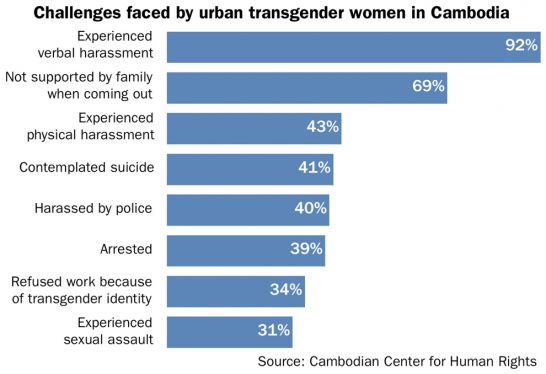
The transgender scene in Cambodia is much more shy than on Bangkok’s streets where ‚ladyboys‘ are visible everywhere. If you want to meet transgender women in Phnom Penh, you’ll find them in the numerous ‚karaoke cabarets‘, on stages in night-clubs, on the streets in red light districts, or working in hair and nail salons. Transgender women have great problems finding employment because of social stigma, so they have to find ways to make money in areas where society tolerates them because of this social sentiment and the lack of laws against discrimination in employment. If a Transgender woman needs to show her ID, they still have to identify themselves as male, which immediately exposes them as ‚fake girls‘. The official Government statement on LGTBIQ rights announced by the Interior Ministry in Cambodia states that they will give more rights to this part of the community when the public groundswell rises to support it.
The perceived pressure to lead life in the wrong body usually leads to a coming-out around the age of 15 which leads to being disadvantaged or abandoned by their family, affecting their school education. Taking a loan from a bank to set-up a business cannot happen without their family’s support as guarantors. In Cambodia, one of the poorest countries in the world, the family provides the social structure, serves as security and protection. Outside of this, the children are destitute and on their own – a bad start to adulthood. Financial pressure is higher than on other children because ‚buying‘ their way back into their family by supporting them financially is sometimes the only path for re-acceptance into the family.
“Injustice anywhere is a threat to justice everywhere. We are caught in an inescapable network of mutuality, tied in a single garment of destiny. Whatever affects one directly, affects all indirectly.” Martin Luther King
 REAL GIRLS